
More drivers across Milton, Pensacola, and the surrounding area are making the switch to electric and hybrid vehicles, and one of the first questions that comes up isn’t about the car — it’s about how to charge it at home. A standard wall outlet works in a pinch, but it’s rarely the setup most EV owners actually want to live with long-term. Here’s what’s worth understanding before you install one.
Level 1 vs. Level 2: What’s the Actual Difference?
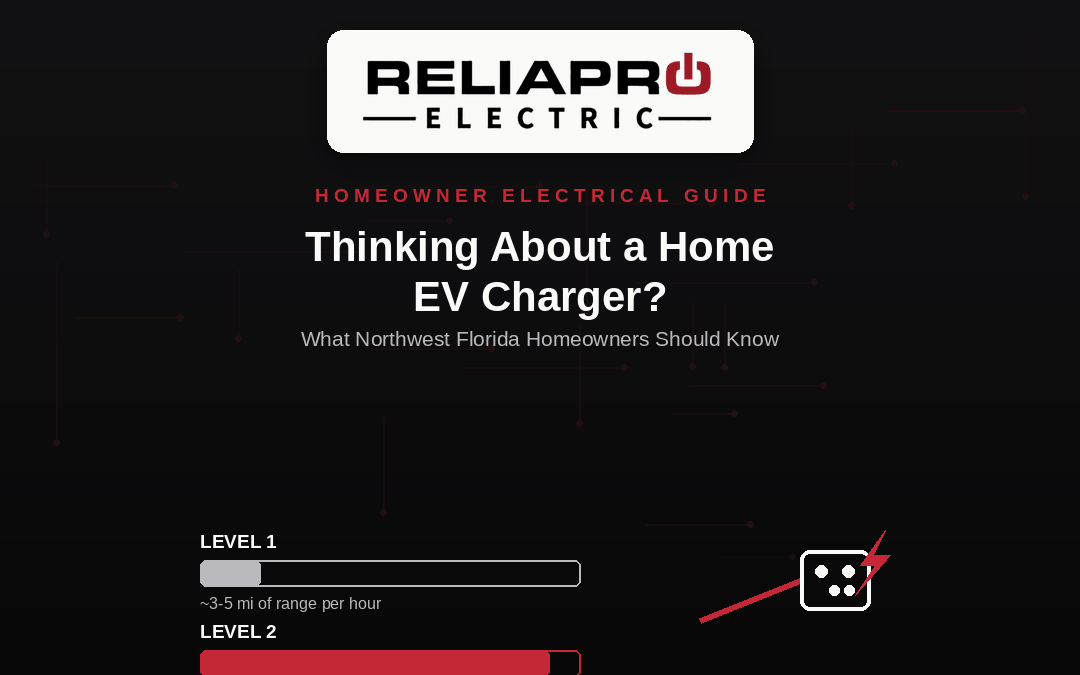
Level 1 charging uses a standard 120-volt household outlet — the same kind everything else in your home plugs into. It works, but it’s slow, typically adding only a few miles of range per hour. For a daily commuter, that can mean charging overnight just to cover a normal day’s driving.
Level 2 charging uses a 240-volt circuit, similar to what an electric dryer or range runs on, and charges roughly 5 to 7 times faster than Level 1. Most homeowners who charge regularly end up installing a Level 2 charger because the difference in daily convenience is significant — a nearly depleted battery can go from empty to full overnight instead of taking days.
What a Level 2 Installation Actually Involves
Installing a Level 2 home charger isn’t just mounting a box on the wall — it typically involves:
- A dedicated 240-volt circuit, sized specifically for the charger’s amperage draw
- A check of your electrical panel’s available capacity, since adding a high-draw circuit means confirming the panel can handle it without being overloaded
- Proper placement, factoring in where you park, cable length, and whether the charger will be indoors, in a garage, or mounted outside
- A permit and inspection, which most jurisdictions require for new circuit installations — this isn’t a step worth skipping, since unpermitted electrical work can complicate a home sale or insurance claim down the line
The Panel Question Most Homeowners Don’t Expect
This is often the part of the process that surprises people. Many homes, especially older ones, have electrical panels that were sized decades ago for a much lighter load — before central air, modern kitchens, and a houseful of electronics were part of the equation. Adding a 240-volt EV charger circuit on top of that can sometimes be the tipping point that requires a panel upgrade rather than a simple new circuit.
This isn’t true for every home — many panels have enough spare capacity to add an EV charger circuit without any other changes. But it’s a question worth answering during a site visit rather than assuming after the charger is already purchased.
Factors That Affect Cost and Complexity
- Distance from the panel to the charging location. A charger installed right next to the electrical panel is a simpler job than one that requires running wire to a detached garage or across the house.
- Panel capacity. As mentioned above, some installs need a panel upgrade or a load management device to accommodate the new circuit safely.
- Indoor vs. outdoor mounting. Outdoor installations require weather-rated equipment and additional considerations for exposure.
- Charger amperage. Higher-amperage chargers charge faster but require larger wire gauges and can push a panel’s capacity further.
Why This Isn’t a DIY Project
EV chargers draw a sustained, high-amperage load for hours at a time — a very different demand than a typical household outlet. Improperly sized wiring, a poorly rated breaker, or a panel that’s already near capacity can create a real fire risk, not just an inconvenience. This is precisely the kind of installation where a licensed electrician’s assessment of your panel, wiring, and circuit sizing matters — not just for a code-compliant install, but for a safe one.
Getting Started
If you’re considering a home EV charger, the most useful first step is a licensed electrician’s assessment of your panel and home’s electrical capacity — before you’ve committed to a specific charger model or mounting location. That assessment will tell you whether it’s a straightforward install or one that involves a panel upgrade, and it’ll help you budget accurately either way.
Reliapro Electric provides EV charger installation throughout Milton, Pensacola, Gulf Breeze, and the surrounding Northwest Florida area, including panel evaluations to determine what your home’s electrical system can support. If you’re ready to explore a home charging setup, request service and we’ll help you figure out the right approach for your home.